Stainless steel exhaust pipes and bends for custom exhaust systems
High-quality exhaust pipes and bends are essential when building, modifying or repairing an exhaust system. At The Autosport Company you will find a wide range of stainless steel exhaust components for road, tuning and motorsport applications. The range includes straight exhaust tubing, various exhaust bends, short-radius manifold bends, articulated bends, flexible exhaust connections and reducers.
Many of these exhaust components are manufactured from 304 stainless steel. This material is widely used for exhaust systems because of its combination of corrosion resistance, heat resistance and durability. The components are therefore suitable for building a complete custom exhaust system or modifying an existing exhaust.
Why use stainless steel for an exhaust system?
An exhaust system is exposed to high temperatures, moisture, dirt and significant temperature fluctuations. Stainless steel is therefore a popular choice for road cars as well as race and rally cars.
Important benefits of stainless steel exhaust components include:
- Good corrosion resistance
- Suitable for high exhaust gas temperatures
- Strong and durable construction
- Suitable for welding and custom fabrication
- Professional appearance
- Suitable for road, tuning and motorsport applications
304 stainless steel exhaust pipe
Many exhaust pipes in our range are manufactured from 304 stainless steel. This is a commonly used grade for exhaust systems and offers a good combination of strength, corrosion resistance and ease of fabrication.
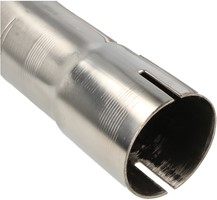
The straight QSP exhaust pipes can be used to build a new exhaust system or replace an existing section. Various versions feature an expanded end that allows the pipe to slide over a compatible exhaust section. Slots in the expanded section also make it possible to secure the connection using a suitable exhaust clamp. The joint can also be welded when a permanent connection is required.
Stainless steel exhaust bends for custom fabrication
Stainless steel exhaust bends allow an exhaust system to be routed accurately around the chassis, bodywork and other vehicle components. This is particularly important where installation space is limited or when building a completely custom exhaust system.
Exhaust bends are available in different diameters, angles and bend radii. This allows the system to be adapted to the available space and the required exhaust route.
Short-radius manifold bends
Short-radius manifold bends are particularly useful when building an exhaust manifold or working in areas where installation space is limited. Their compact bend radius allows the exhaust gas path to change direction within a relatively small area.
These bends are commonly used for custom exhaust manifolds, turbo installations and other fabrication work where a conventional exhaust bend would require too much space.
Stainless steel articulated exhaust bends
Articulated bends are useful where a conventional single bend does not provide enough flexibility. By positioning the different bend sections relative to one another, more complex exhaust routes can be created.
This type of component can be especially useful on vehicles where space around the chassis, rear axle, transmission or other components is limited.
Stainless steel exhaust reducers
When two exhaust components with different diameters need to be connected, a stainless steel reducer can be used. This allows a transition from a smaller to a larger exhaust diameter or vice versa.
QSP stainless steel reducers are designed for building and modifying exhaust systems. Depending on the version, they feature an expanded and slotted end that can be secured using a suitable clamp. They can also be welded when a permanent connection is required.
Flexible exhaust connections
A flexible exhaust connection helps absorb movement and vibration between the engine and exhaust system. During acceleration, gear changes and deceleration, the engine moves relative to the vehicle body. Without sufficient flexibility this movement can create stress in exhaust pipes, welds, flanges and mounting points.
A correctly selected flex section can help absorb this movement and is therefore an important part of many custom exhaust systems.
What diameter stainless steel exhaust pipe do I need?
The correct diameter depends on several factors, including engine type, engine power, displacement, turbocharger or supercharger configuration and the desired characteristics of the exhaust system.
Common exhaust pipe diameters include:
- 50.8 mm – 2 inch
- 57 mm – approximately 2.25 inch
- 63.5 mm – 2.5 inch
- 70 mm
- 76 mm – 3 inch
A larger exhaust diameter does not automatically provide better performance. An excessively large system can alter exhaust gas behaviour, while a pipe that is too small can become restrictive. The diameter should therefore be matched to the engine and intended application.
Expanded exhaust pipe connections
Some universal stainless steel exhaust components have an expanded end. This allows a compatible exhaust part to slide into or over the expanded section and makes it easier to combine several universal components.
If the expanded end is slotted, a suitable exhaust clamp can be used to secure the joint and create a removable connection. For a permanent installation, the components can also be welded together.
Building your own stainless steel exhaust system
By combining straight tubing, bends, reducers, flex sections and suitable connections, it is possible to build a complete custom exhaust system. Start by determining the required pipe diameter and then plan the route of the system underneath the vehicle.
Important points to consider include:
- Adequate clearance from the body and chassis
- Distance from fuel lines, brake lines and electrical wiring
- Room for engine and drivetrain movement
- Correct positioning of flex sections
- Sufficient and correctly positioned exhaust hangers
- Accessibility of removable exhaust connections
Correct alignment helps prevent unnecessary stress on the exhaust system and reduces the risk of damage to welds, flanges and mounting points.
Welding or clamping a stainless steel exhaust?
The best installation method depends on the required result. Welding creates a permanent connection and is widely used for fully custom exhaust systems. Expanded pipe sections and exhaust clamps allow the system to remain more easily removable.
V-band connections can also be used where parts of the exhaust system need to be removed regularly. This is particularly useful on race cars and other vehicles that require frequent maintenance.
Stainless steel exhaust components for race and rally cars
Motorsport exhaust systems operate under demanding conditions. High engine speeds, high temperatures and vibration place significant loads on the materials and connections used.
Stainless steel exhaust pipes and bends are therefore widely used on race cars, rally cars, track cars and other competition vehicles. By combining individual universal components, the system can be tailored to the available space and vehicle configuration.
Frequently asked questions about stainless steel exhaust pipes and bends
Which grade of stainless steel is used for exhaust tubing?
Many QSP exhaust pipes and other exhaust components in this category are manufactured from 304 stainless steel. This material is widely used for exhaust systems because of its good corrosion and temperature resistance.
Can stainless steel exhaust pipe be welded?
Yes. Stainless steel exhaust tubing can be welded using a suitable welding process and filler material. Experience with welding thin-wall stainless steel is recommended for a clean and durable result.
Can stainless steel exhaust parts be installed without welding?
Yes, where the design allows it. Some exhaust pipes and reducers have expanded and slotted ends that can be secured using a suitable exhaust clamp.
What is the difference between a normal exhaust bend and a manifold bend?
A manifold bend normally has a tighter radius and is suitable for compact fabrication work such as building an exhaust manifold. A conventional exhaust bend generally has a wider radius and is used to route the main exhaust system.
Can I connect different exhaust pipe diameters?
Yes. A stainless steel reducer can be used to connect two different exhaust diameters. Always select a reducer that matches the inside and outside diameters of the components being used.
Order stainless steel exhaust pipes and bends from The Autosport Company
At The Autosport Company you will find stainless steel exhaust pipes, exhaust bends, manifold bends, articulated bends, reducers and flexible connections for building and modifying exhaust systems.
Whether you are building an exhaust for a road car, tuning project, race car or rally car, the different stainless steel components allow you to create a system that matches your vehicle and application.
Browse the current range above and select the correct diameter, bend and configuration for your exhaust system.