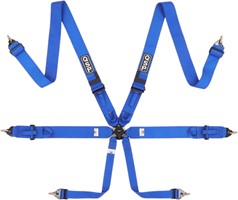
Racing Harnesses and Safety Belt Accessories for Motorsport
A properly selected racing harness is a fundamental part of a competition car's driver safety equipment. Working together with a suitable racing seat, mounting arrangement and other protective systems, the harness helps restrain the driver and maintain the intended seating position during demanding motorsport conditions.
The Autosport Company offers racing harnesses and accessories for circuit racing, rallying, track days, drifting and performance vehicle applications. Our selection covers FIA-homologated competition harnesses, SFI racing harnesses, selected street and tuning seat belts, and mounting components for suitable installations.
With different belt configurations, webbing widths, buckle designs and adjustment systems available, selecting the correct harness starts with understanding the vehicle's intended use and the requirements of the relevant motorsport organisation.
Different Types of Racing Harnesses
Not all racing harnesses are designed for the same purpose. A harness intended for professional competition may have very different approval and installation requirements from a belt developed for a performance road car.
Our selection is divided into specialist product categories:
- FIA racing harnesses for competition applications requiring an appropriate FIA homologation.
- SFI racing harnesses for selected motorsport categories operating under SFI specifications.
- Street and tuning harnesses for suitable road and trackday applications.
- Racing harness accessories for installation, adjustment and additional safety equipment.
- A complete racing harness collection for comparing available models.
Each harness must be evaluated as a complete safety system. Its approval, mounting points, webbing arrangement and compatibility with the racing seat are more important than appearance alone.
FIA Racing Harnesses for Circuit Racing and Rally
Many regulated motorsport competitions require racing harnesses carrying an appropriate FIA homologation.
Modern FIA competition harnesses are commonly manufactured in accordance with FIA 8853-2016, although the required standard depends on the championship and vehicle regulations.
Six-point harnesses are widely used in professional circuit racing and rally vehicles. A typical configuration includes two shoulder straps, two lap straps and two anti-submarine straps connected through a central buckle.
Different designs offer options such as:
- Two-inch or three-inch shoulder webbing.
- Shoulder straps designed for compatible FHR systems.
- Pull-up or pull-down lap belt adjustment.
- Different adjuster positions for cockpit accessibility.
- Steel or aluminium adjusters, depending on the model.
- Specific bolt-on or snap-hook anchorage arrangements.
- Different strap lengths and colour options.
Before entering a competition, check the harness homologation label, validity date and any additional installation requirements specified by the event organiser.
Explore our FIA racing harnesses for suitable competition belts.
Three-Point, Four-Point, Five-Point and Six-Point Harnesses
The number of harness points describes the strap and anchorage arrangement used to restrain the occupant.
Three-Point Seat Belts
Three-point systems normally combine a lap section with a diagonal shoulder strap. This is a common arrangement in road vehicles, and selected sport-oriented versions are also available for compatible applications.
For public road use, the specific belt and complete installation must comply with applicable vehicle approval requirements.
Four-Point Racing Harnesses
A four-point harness uses two shoulder straps and two lap straps. These designs are found in certain trackday cars, performance vehicles and specialised motorsport applications.
However, not all four-point harnesses are homologated for competition or approved for public road use. The design of the seat and the harness's anti-submarining characteristics must also be considered.
Five-Point Safety Harnesses
Five-point systems typically incorporate a single anti-submarine strap in addition to the shoulder and lap sections.
They are used in certain motorsport disciplines and specialised vehicle configurations. Their suitability depends on the applicable technical standard and racing organisation.
Six-Point Competition Harnesses
Six-point harnesses include two separate anti-submarine straps designed to work with the shoulder and lap belts.
These systems are widely selected for competition vehicles where the racing seat and anchorage arrangement are designed for a six-point configuration.
Correct routing and positioning of all straps are essential for effective restraint.
SFI Racing Harnesses for Motorsport
SFI is a separate motorsport standards system used in a variety of racing categories, particularly within North American motorsport.
Depending on the discipline, competition organisers may require a harness meeting a specific SFI standard rather than an FIA homologation.
SFI harnesses are available in different configurations and can feature specialised fastening or adjustment arrangements for their intended application.
Do not assume that FIA and SFI approvals are interchangeable. The harness must meet the rules of the championship in which it will be used.
Browse our SFI racing harnesses for available models.
Street and Trackday Harnesses
Performance road cars and trackday vehicles may use different restraint equipment from fully regulated competition cars.
Our street and tuning range includes selected three-point and four-point harnesses, including models carrying ECE approval for their specified applications.
It is important to distinguish between motorsport homologation and road vehicle approval. An FIA racing harness is not automatically suitable or approved for public road use, while an ECE-approved belt is not necessarily permitted in a racing championship.
Replacing original seat belts can also affect interactions with factory seats, airbags and other occupant protection systems.
Always verify the intended use, relevant approval markings and vehicle-specific installation requirements before purchasing.
Discover our street and tuning harnesses for suitable performance car applications.
Two-Inch and Three-Inch Harness Webbing
Harness webbing width varies depending on the model and intended application. Two common dimensions are two inches, approximately 50 mm, and three inches, approximately 76 mm.
Some competition harnesses use narrower shoulder straps specifically designed to sit correctly over compatible FHR devices.
Other designs use wider shoulder sections, with the lap and anti-submarine straps having different dimensions.
Webbing width alone should never determine harness selection. Consider the full belt design, homologation, seat compatibility and any requirements associated with the head and neck restraint system.
FHR and HANS-Compatible Racing Harnesses
Frontal Head Restraint systems, including HANS devices, are designed to help control head movement relative to the torso during certain impacts.
These devices operate as part of a combined safety arrangement involving the helmet, shoulder belts, racing seat and vehicle mounting points.
A racing harness intended for FHR use must provide appropriate shoulder strap routing and be compatible with the selected restraint device.
Always follow the harness and FHR manufacturers' instructions regarding shoulder belt position, strap width and installation geometry.
Competition organisers may also require specific FHR equipment for the class or event.
Harness Buckles and Adjustment Systems
Different harness designs offer different buckle mechanisms and methods of adjustment.
Competition harnesses commonly use a central rotary release buckle designed to connect multiple straps and provide a clearly accessible release mechanism.
Selected street-oriented belts can use alternative buckles, including push-button designs where permitted for the intended application.
Lap belt adjusters may be configured for pull-up or pull-down operation. The most practical choice depends on the racing seat, available cockpit space and the driver's reach.
Before buying a harness, consider how easily the belts can be tightened and released while the driver is fully seated.
Racing Harness Installation Accessories
Completing a racing harness installation may require specific anchorage hardware or additional accessories.
Our racing harness accessories selection includes:
- Eye bolts for suitable harness mounting arrangements.
- Threaded backing plates and anchorage plates.
- Harness snap hooks and specific connection components.
- Harness adjuster sliders for selected webbing widths.
- Two-inch and three-inch shoulder belt pads.
- Harness cutters and emergency safety accessories.
- Selected replacement components for compatible harness systems.
Individual components should only be used where their specifications and the manufacturer's instructions permit the intended installation.
Replacing or modifying parts of a homologated competition harness may invalidate its approval. Never assume that a visually similar buckle, adjuster or strap component is an acceptable substitute.
Visit our racing harness accessories category for mounting and safety equipment.
Correct Racing Harness Installation
The effectiveness of a harness depends on the complete restraint installation, not simply the number of belt points or the strength of the webbing.
Harness mounting points must be designed to accommodate the expected loads and must comply with the relevant manufacturer instructions and motorsport regulations.
Important installation considerations include:
- Choosing a racing seat compatible with the harness configuration.
- Using suitable structural anchorage points.
- Routing shoulder straps at the angles specified for the installation.
- Positioning lap straps low across the pelvis rather than the abdomen.
- Routing anti-submarine straps through appropriate seat openings.
- Preventing twisted webbing and contact with sharp edges.
- Ensuring adjusters and buckles remain accessible.
- Checking adequate strap length for the driver's seating position.
- Following the relevant championship's technical requirements.
Harnesses must not be attached to arbitrary seat components, thin body panels or unsuitable structural points.
Because racing harness installation is safety-critical, professional installation is strongly recommended where the required experience or technical documentation is unavailable.
FIA Harness Expiry Dates and Regular Inspection
Competition harnesses can carry homologation labels showing the relevant standard, identification and expiry information.
For FIA-regulated events, the harness must remain valid according to the applicable rules. Inspect its labels before competition and confirm whether any additional championship restrictions apply.
Regular physical inspection is equally important. Check for:
- Frayed, cut or abraded webbing.
- Damaged stitching.
- Faulty buckle engagement or release.
- Worn or damaged adjustment hardware.
- Corrosion or deformation of anchorage components.
- Heat, chemical or impact-related damage.
A harness showing signs of damage should not remain in service. Equipment subjected to significant accident loading must be handled according to the manufacturer's replacement requirements.
Frequently Asked Questions About Racing Harnesses
What is the difference between a four-point and six-point harness?
A four-point harness uses two shoulder and two lap straps. A six-point harness adds two anti-submarine straps. The correct configuration depends on the racing seat, intended application and relevant safety regulations.
Which racing harness do I need for competition?
That depends on the championship rules. Certain events require FIA-homologated harnesses, while others specify SFI-certified equipment. Always check the applicable standard and validity requirements.
What is FIA 8853-2016?
FIA 8853-2016 is a technical homologation standard for competition safety harnesses. A harness carrying this homologation must be used according to its approval conditions and the relevant sporting regulations.
Are FIA and SFI racing harnesses interchangeable?
Not automatically. FIA and SFI are separate standards systems. A harness must comply with the specific requirements of the event or racing category.
Can I use a four-point harness on public roads?
Only when the specific harness and its complete installation are approved and suitable under the applicable vehicle regulations. A non-FIA designation does not automatically mean road approval.
Do I need a special harness when using a HANS device?
The harness must be compatible with the FHR/HANS device and racing seat. Correct shoulder strap positioning and manufacturer-approved installation are essential.
What is the difference between two-inch and three-inch harness straps?
The dimensions refer to webbing widths of approximately 50 mm and 76 mm. The correct width depends on the harness design, intended application and compatibility with other safety equipment.
What do pull-up and pull-down harness adjustments mean?
These terms describe how the lap belt adjustment mechanisms are operated. The most convenient version depends on cockpit accessibility and the driver's seating position.
Can I install harness eye bolts and anchorage plates myself?
The mounting points must meet specific structural and installation requirements. Safety-critical harness anchorage work should follow the manufacturer's instructions and applicable racing regulations, with specialist installation where necessary.
How long is an FIA racing harness valid?
Check the homologation labels and the applicable event regulations. The harness must remain within its permitted validity period and be in suitable physical condition.
Buy Racing Harnesses and Accessories at The Autosport Company
The Autosport Company offers a wide range of safety harnesses and accessories for circuit racing, rallying, track days, drifting and performance vehicle projects.
Choose from FIA competition harnesses, SFI racing belts, suitable street and tuning harnesses, and installation accessories including eye bolts, anchorage plates, shoulder pads and emergency belt cutters.
Whether you are assembling a new race car cockpit or replacing existing safety equipment, we can help identify products suitable for your requirements.
Explore our complete racing harness range, order online or visit our showroom in Waalwijk, the Netherlands, for personal advice.