Roll Cages and Roll Bar Accessories for Motorsport
Building a competition car requires careful attention to occupant protection and vehicle safety. A properly designed and installed roll cage helps preserve the space around the occupants during certain accidents and forms an important part of the vehicle's overall safety structure.
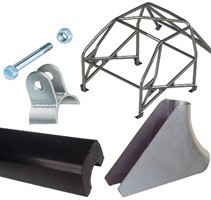
The Autosport Company offers roll cages and accessories for circuit racing, rallying, drifting and other motorsport applications. Our selection includes vehicle-specific racing roll cages, protective roll bar padding, joining components, reinforcement plates and steel gussets for compatible roll cage constructions.
Whether you are preparing a new rally car, building a dedicated track vehicle or sourcing components for an existing safety cage, our range brings together specialist products for different installation requirements.
Roll Cage vs Roll Bar: Understanding the Difference
Although the terms roll cage and roll bar are sometimes used interchangeably, they can describe different structural arrangements.
Roll Bars
A roll bar is generally a hoop-shaped structure installed at a designated position within the vehicle, commonly behind the front occupants.
Depending on its design, a roll bar may incorporate additional supporting members and specific mounting arrangements.
Its permitted application and protective function depend on the complete construction and applicable technical requirements.
Full Roll Cages
A full roll cage normally consists of several connected structural tubes forming a protective framework around the occupants.
Depending on the vehicle and design, the assembly may include a main hoop, front hoop, roof members, rear stays, diagonal braces and door protection bars.
The configuration must comply with the requirements of the intended racing category. Simply adding more tubes does not automatically make a cage eligible for competition or improve its suitability for every application.
Vehicle-Specific Racing Roll Cages
Many competition roll cages are developed for particular makes, models, production years and body configurations.
A vehicle-specific design takes account of the intended cabin dimensions and mounting arrangement. However, installation work and vehicle modifications may still be necessary.
Our collection includes roll cages for a variety of competition cars, with different structural configurations and materials depending on the specific product.
Before ordering, verify:
- The vehicle manufacturer and exact model.
- The production year and body style.
- Whether the cage is intended for the correct number of doors.
- The supplied cage configuration and attachment points.
- The presence and design of diagonal and door reinforcement bars.
- Tube material and relevant product specifications.
- Required installation work and mounting components.
- Compatibility with the intended racing regulations.
A roll cage listed for a vehicle model is not automatically compatible with every variant of that model.
Browse our vehicle-specific roll cages to compare available applications.
Bolt-In and Weld-In Roll Cage Construction
Roll cages can be supplied in different forms, including designs assembled using specified bolted connections and constructions requiring welded tube joints.
Bolt-In Racing Roll Cages
A bolt-in cage uses dedicated joining components to connect certain sections of the safety structure.
However, the term bolt-in does not necessarily mean that the installation can be completed without welding.
Selected cage systems require reinforcement plates to be welded to the body structure. Door bars may need to be prepared to the required length, and additional attachment points may require welding.
Always review the installation requirements of the exact roll cage rather than assuming that a bolt-in design is a simple DIY installation.
Weld-In Roll Cages
Weld-in safety cages require suitable welding procedures and correct positioning of the structural members.
The quality of the finished installation depends on the approved design, suitable material, fabrication accuracy and workmanship.
Welding and structural modification of roll cages should be performed by specialists experienced in motorsport safety cage construction.
Roll Cage Accessories and Tube Connections
Specialist roll cage accessories are available for designated tube joints and mounting arrangements.
Depending on the design, a roll cage assembly may use dedicated couplings, connecting sleeves or reinforcement components.
Our assortment includes:
- Roll cage fork-type connecting components.
- Dedicated connection pins.
- Tube joining sleeves.
- Vehicle body reinforcement components.
- External reinforcement plates.
- Selected joining parts for compatible roll cage systems.
Some connecting components are intended for tube diameters such as 40 mm and 50 mm, depending on the product.
When selecting a roll cage connection, check the tube dimensions, construction material, joint design and required assembly method.
Not all connectors can be combined with every safety cage. A part that fits the tube diameter may still be unsuitable for the intended structural application.
Explore our roll cage accessories for compatible connection and reinforcement components.
FIA Roll Cage Padding for Driver Protection
The metal tubes of a roll cage may be located close to the driver's helmet, shoulders and other parts of the body.
During an accident, contact with an unprotected tube can result in substantial impact loads. Suitable roll cage padding is used at prescribed locations to help manage these impacts.
Our range includes FIA-approved roll cage padding and non-FIA protective foam products for applications where the corresponding competition approval is not required.
FIA 8857-2001 Type A Padding
For certain competition applications, the regulations require padding complying with FIA Standard 8857-2001 Type A in specified locations.
This material is engineered for the relevant impact and fire performance requirements. FIA roll cage padding commonly features a shaped impact surface rather than a simple cylindrical foam profile.
Correct positioning is essential. The padding must be fitted to suitable tubes and secured using the method required by the manufacturer and applicable regulations.
Always check the precise FIA approval of the product rather than assuming that any padding described as racing foam complies with the standard.
Non-FIA Roll Bar Padding
Non-FIA padding is available for selected custom vehicle, show car and other applications that do not require FIA-homologated roll cage padding.
Depending on the product, the material may be manufactured from flame-retardant foam with a profile designed to fit around a suitable tube.
Non-FIA padding should not be substituted for FIA-approved protection where a specific FIA standard is mandatory.
Browse our roll cage padding to compare the available designs and dimensions.
Choosing the Correct Roll Cage Padding Size
Roll cage padding must be selected for the external diameter of the tube and the shape of the protective material.
Different products are intended for different tube dimensions, with selected options covering diameter ranges such as 29–38 mm and 45–51 mm.
Before choosing padding, consider:
- The outside diameter of the cage tube.
- The dimensions and cross-sectional profile of the padding.
- Any FIA approval required for competition.
- The position of the tube relative to the driver's helmet.
- Available cockpit clearance.
- The approved installation and retention method.
Padding must be fitted securely so that it cannot move unintentionally along the tube.
For competition use, the precise locations requiring approved padding must be checked against the current technical regulations.
Steel Roll Cage Gussets and Reinforcement Plates
Gussets are reinforcing components used in suitable tubular structures and specific joint arrangements.
In motorsport fabrication, steel gussets may be incorporated into a roll cage design to support designated tube intersections or structural connections.
Our selection includes different designs such as:
- Open steel gussets.
- Closed steel gussets.
- Curved reinforcement gussets.
- A-pillar support gussets.
- Steel reinforcement plates for suitable fabrication applications.
Different shapes allow components to be selected for particular joint geometries and design requirements.
The correct gusset type depends on the approved construction, tubing dimensions and intended location.
Adding gussets to an existing cage does not automatically increase its regulatory compliance. Unauthorised modifications to a homologated or certified safety cage may invalidate its approval.
Explore our roll cage gussets and reinforcement plates for the available designs.
Roll Cage Tube Materials and Structural Requirements
The construction of a motorsport safety cage involves carefully specified materials and tube dimensions.
Depending on the application, different approved steel materials may be used. Tube diameter, wall thickness and the construction of each joint all contribute to the mechanical behaviour of the completed assembly.
The permitted design must be established from the applicable regulations or the manufacturer's homologation documentation.
Do not select tubing or joining parts solely on appearance or because their dimensions seem similar to those of another cage.
Replacing structural members with unapproved alternatives or changing the original design can affect both safety and competition eligibility.
FIA Safety Cage Regulations
Many motorsport categories have specific requirements for safety cage design, construction and installation.
For several FIA-regulated vehicle classes, the relevant provisions are contained in Appendix J, including Article 253 and related regulations where applicable.
Depending on the class and vehicle, a cage may need to follow prescribed construction requirements or be covered by specific certification or homologation documentation.
Not every aftermarket roll cage is individually FIA homologated. A product's advertised racing application should therefore be distinguished from the approval required for competition.
Where a cage is homologated or certified, the corresponding identification and documentation may be required during technical inspection.
Always check the current championship regulations and the manufacturer's documentation before purchasing or modifying a safety cage.
Planning a Complete Motorsport Safety Installation
A racing roll cage should be considered as part of the complete cockpit safety system.
The installed structure must allow appropriate positioning of the racing seats, seat belts and other driver protection equipment.
When planning a roll cage installation, important considerations include:
- The exact vehicle and permitted cage design.
- Correct structural attachment points.
- Approved tube materials and joint construction.
- Installation space around the occupants.
- Helmet and roof clearance.
- Seat position and harness anchorage arrangements.
- Door bars and occupant access.
- Required roll cage padding.
- Emergency exit accessibility.
- Any event-specific safety requirements.
Installation can involve welding, interior modifications and specialist structural work. Because a safety cage is a critical component, professional installation is strongly recommended.
Frequently Asked Questions About Roll Cages
What is the difference between a roll bar and a roll cage?
A roll bar is typically a hoop-shaped protective structure. A full roll cage consists of a more extensive arrangement of tubes around the occupants. The permitted construction depends on the vehicle and application.
Are racing roll cages universal?
Many roll cages are vehicle-specific. Check the exact make, model, production year and body configuration before ordering.
Does a bolt-in roll cage require welding?
It may. Certain bolt-in cage systems still require welded body reinforcement plates, prepared door bars or welded attachment points. Always check the installation instructions.
What is FIA roll cage padding?
FIA roll cage padding is protective material approved to a specific FIA safety standard. FIA 8857-2001 Type A padding may be required at designated locations in certain competition vehicles.
Can non-FIA roll bar padding be used for racing?
Only where the applicable technical regulations permit it. Ordinary non-FIA foam is not a substitute for FIA 8857-2001 Type A padding when that standard is mandatory.
How do I choose the correct padding diameter?
Measure the outside diameter of the roll cage tube and select padding designed for that dimension. Also confirm any required approval and the correct installation method.
What are roll cage gussets used for?
Gussets are reinforcing components intended for specified tube joints or structural connections. Their correct application depends on the design, tube geometry and applicable technical requirements.
Can I weld additional reinforcements onto my roll cage?
Not automatically. Modifying a homologated or certified cage may invalidate its approval. Check the relevant documentation and consult a qualified motorsport fabricator.
Is a roll cage mandatory in motorsport?
This depends on the vehicle class and event regulations. Many official racing and rally categories require a suitable safety cage, but the exact rules vary.
Can I install a racing roll cage in a road car?
A racing roll cage is not automatically suitable or approved for public road use. Occupant contact with exposed tubes can introduce additional risks, particularly without the appropriate safety equipment. The complete vehicle installation must be assessed.
Buy Roll Cages and Accessories at The Autosport Company
The Autosport Company supplies roll cages, roll bars and specialist accessories for circuit racing, rallying, drifting and other competition vehicle applications.
Explore vehicle-specific roll cage systems, tube connecting components, FIA and non-FIA protective padding, steel gussets and reinforcement plates.
Whether you are building a dedicated competition vehicle or looking for compatible components for an existing safety cage, we can help you identify suitable products.
Contact our team with your vehicle details and intended application, order online or visit our showroom in Waalwijk, the Netherlands, for product advice.